
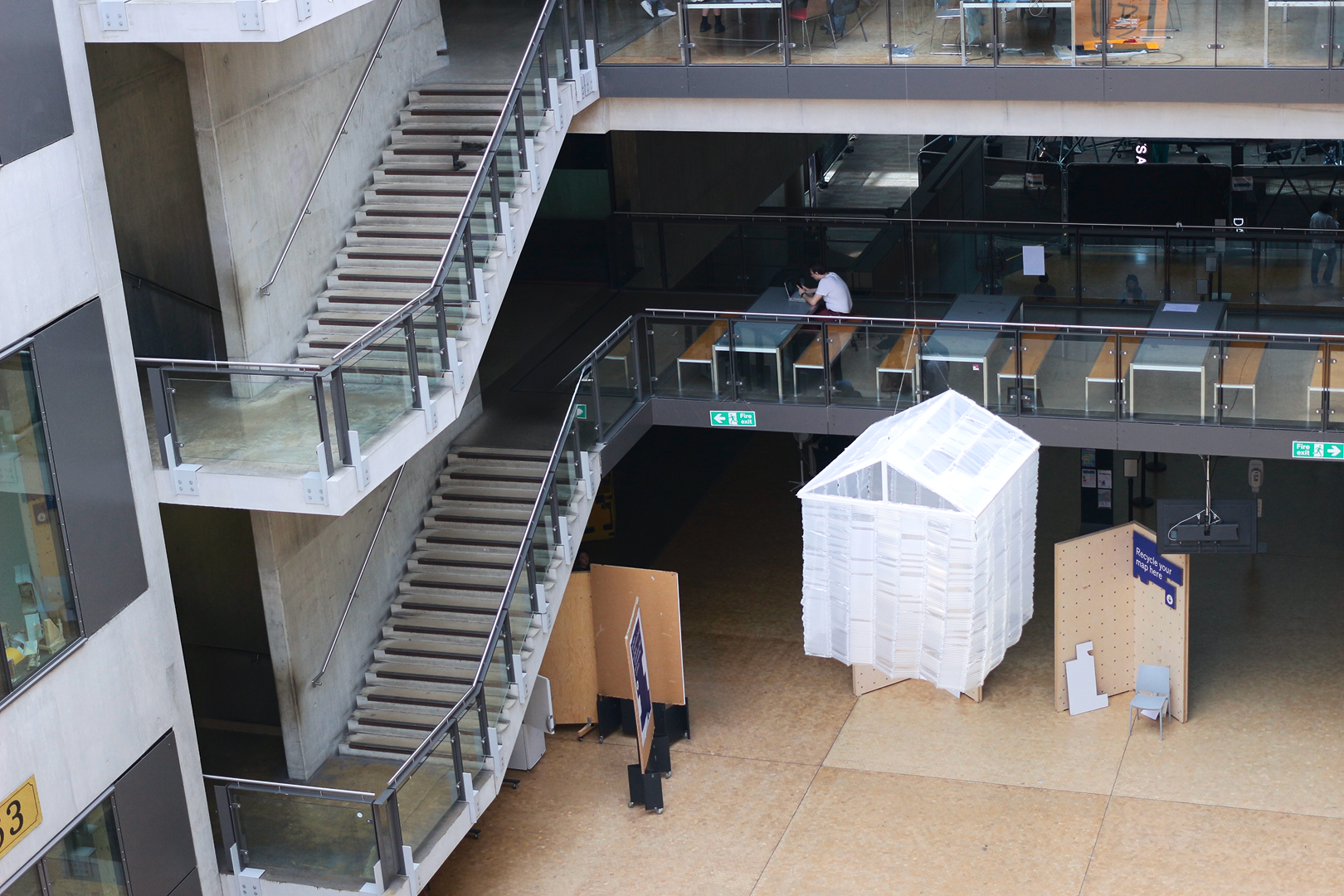
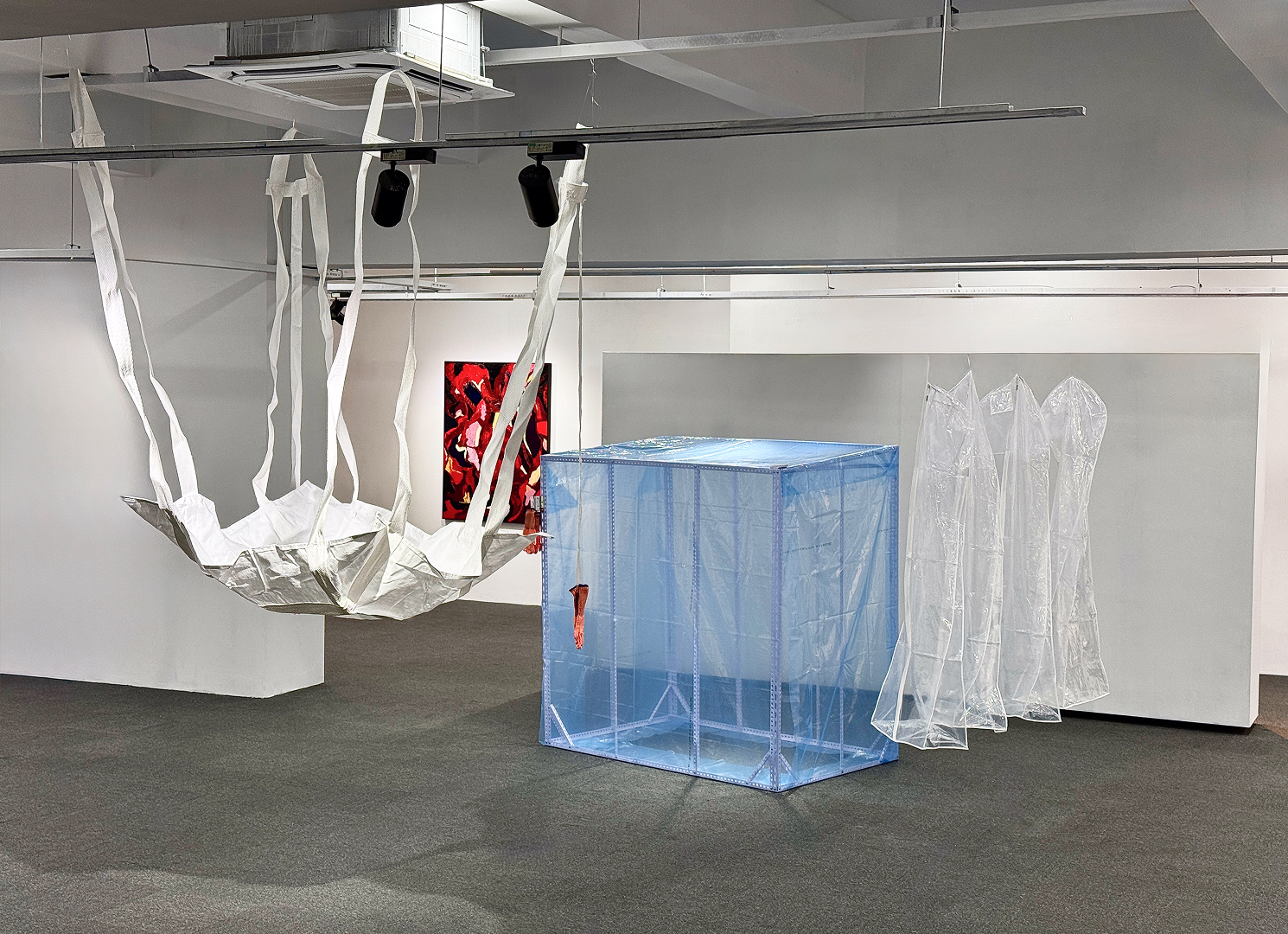
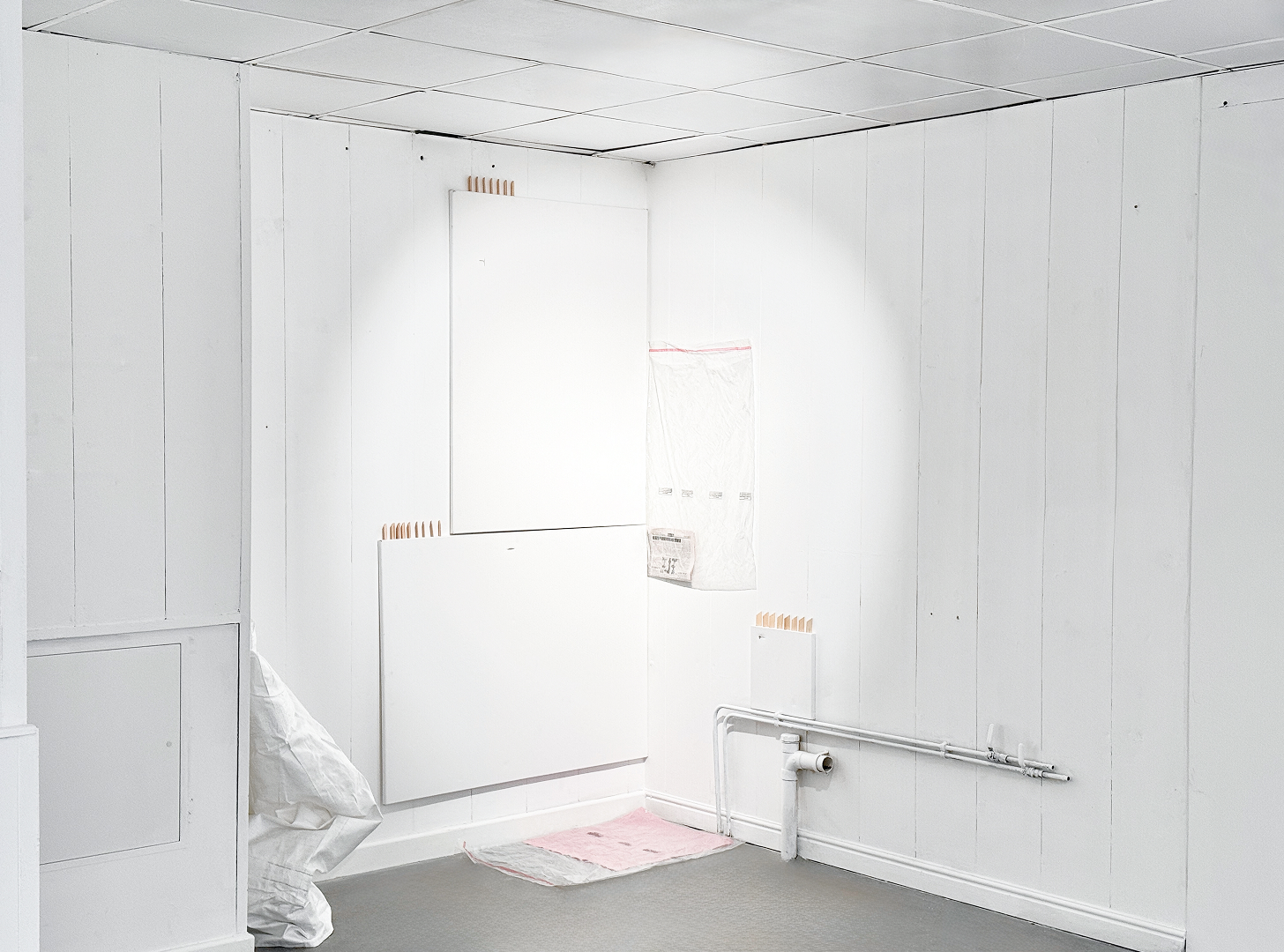
Jichi Zhang is concerned with temporary, post-industrial materials—used plastic packaging, plastic sheathing, and transparent industrial covering. These things, intended to hold or protect, are rendered purposeless and meaningless. In Zhang's paintings, they are delicate conveyances of gesture, suspended in an unresolved tension between figure and decay.
Folded, pressed, or lightly arranged, the materials resist permanence. A crease may soften over time, and a surface may shift due to air pressure. His works are states of becoming—quiet, unstable, and open-ended.
Rather than force form onto the material, Zhang works in collaboration with it. Some pieces are barely touched, almost invisible against the wall; others are gently manipulated until they hold creases that feel like memory, accidental but persistent. The frosted surfaces blur the boundary between interior and exterior, visibility and concealment. These pieces are not didactic or symbolic; they ask to be encountered rather than interpreted. They trace states of hesitation, presence, and retreat.
His installations respond to space with subtlety. They do not dominate their environment but dissolve into it, activated by light, time, and proximity. A sheet may curl or collapse, a folded corner may tremble. This is not failure, but part of the work’s logic. Viewers are invited to approach closely, to adjust their pace, to stay with ambiguity. Zhang understands context as something more than physical—it is emotional, atmospheric, shaped by the conditions surrounding the work rather than fixed structures.
Recent works, am, pursues these concepts further. The title pulls one word from a sentence—am, no longer an action verb with an object. It suggests a state of suspended being, of being half-present. The works in am, like the word itself, are in a state of in-betweenness: neither formed nor undone. Zhang, in this work, approaches impermanence not as a moment of loss, but as a fundamental and generative state.
Zhang's work resists the regimes of visibility, exhibition, and production. He is slow, quiet, and spectacle-proof. He adopts fragility as form and disappearance. He questions the structures of visibility, exhibition, and making. His work is quiet, slow, and resistant to spectacle. He engages fragility as form, and disappearance as a mode of persistence. The pieces do not present conclusions. They remain translucent, trembling, barely there, yet insistently present.
Artist Web Site https://www.jichizhang.com/ |