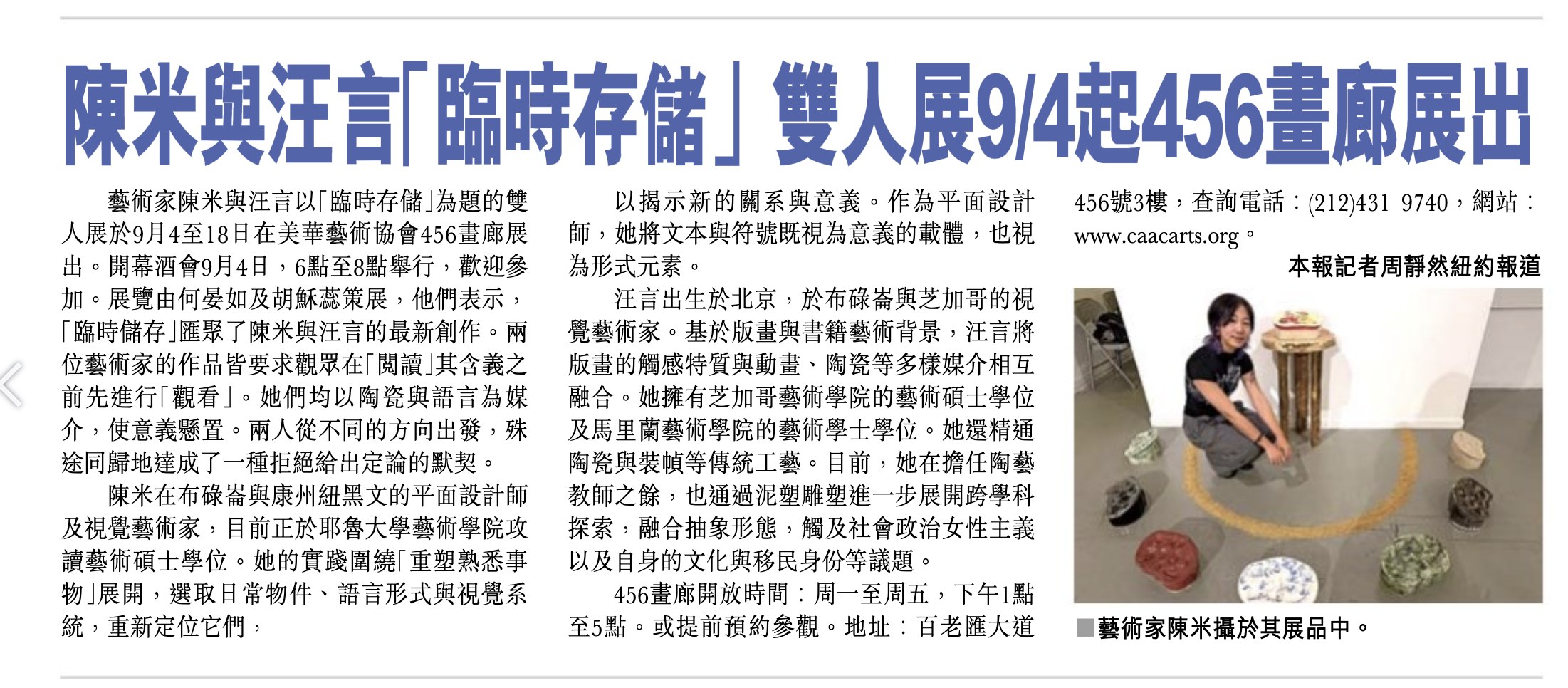
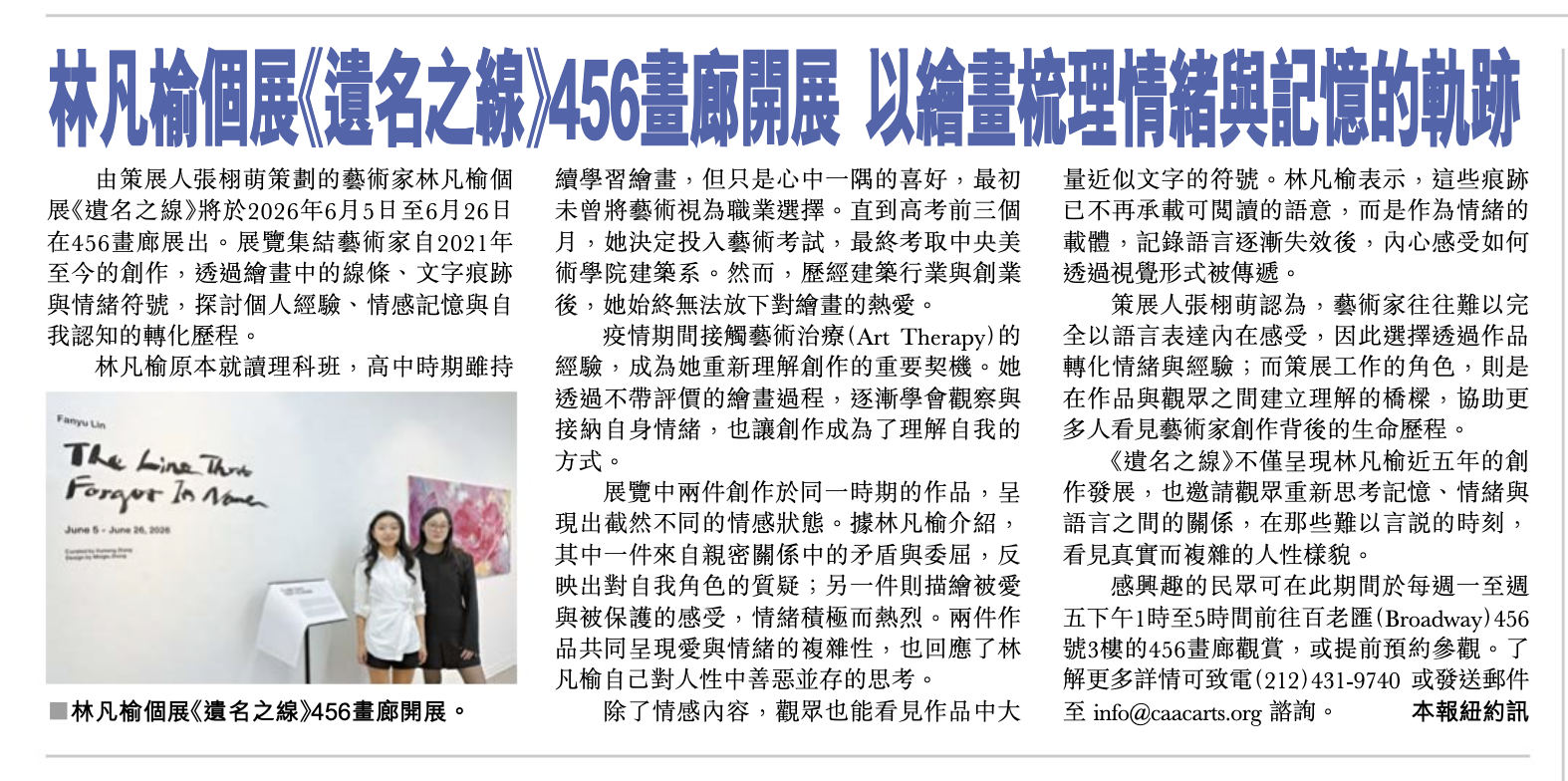
| 2026.2.12 | [Sing Tao Daily/星島日報] 藝術家劉雨桐《聲聲私》個展 2月12至26日456畫廊展出 ....more華人藝術家劉雨桐以《聲聲私》為題的個展,於2026年2月12日至26日在美華藝術協會456畫廊展出。開幕酒會2月12日晚6點至8點,歡迎喜愛藝術者參加。
劉雨桐表示,展覽摡念來自老子的無為思想,《susurrus聲聲私》將討論延伸至形式如何經由其所保留、所隱去之物而發聲。她說老子「道德經」所指,車之所以能行,憑借的是車轂中的孔洞,使輻條與輪得以貫通。器之所以能盛,在於其內的虛空。
房間之所以成為房間,源於四壁被開鑿出的門與窗——那些使身體得以進入、空氣得以穿行、光線得以停留的開口。正是「缺席」的條件,使結構得以運作。形式賦予結構,空無賦予功能。
正如老子所指,此處之「用」生於有與無之間的張力︰實與虛並置運作,缺席並非被動的讓渡,而是其得以為用的條件。劉雨桐的實踐建立在對「空」的理解之上︰中空是共振與調諧得以發生的前提。
她以雕塑與聲音為媒介,將中空的模塊配置為遞歸的組合結構,拒絕完全的封閉與穩定的形式。
空氣從腔體中以連續而微弱的方式流出,凝成停留的私語,貼近身體而不向外擴散。
畢業於羅德島設計學院雕塑系的她,在實踐中將這些感受賦形。她運用重覆與錯位制造缺席,將結構松動之處視作使新的可能性浮現的空隙。
她的實踐與「道」,「無為」的觀念共鳴,創作經由隨勢的直覺自然展開。
劉雨桐,2002年出生於中國北京,現生活和工作於美國紐約。
她於2025年獲得羅德島設計學院(Rhode Island School of Design,RISD)雕塑專業藝術學士學位。
456畫廊開放時間︰周一至周五,下午1點至5點。或提前預約參觀。地址︰百老匯大道456號3樓,電話︰(212)431 9740。如需更多信息,請聯繫info@caacarts.org。本報記者周靜然紐約報道
....more
|
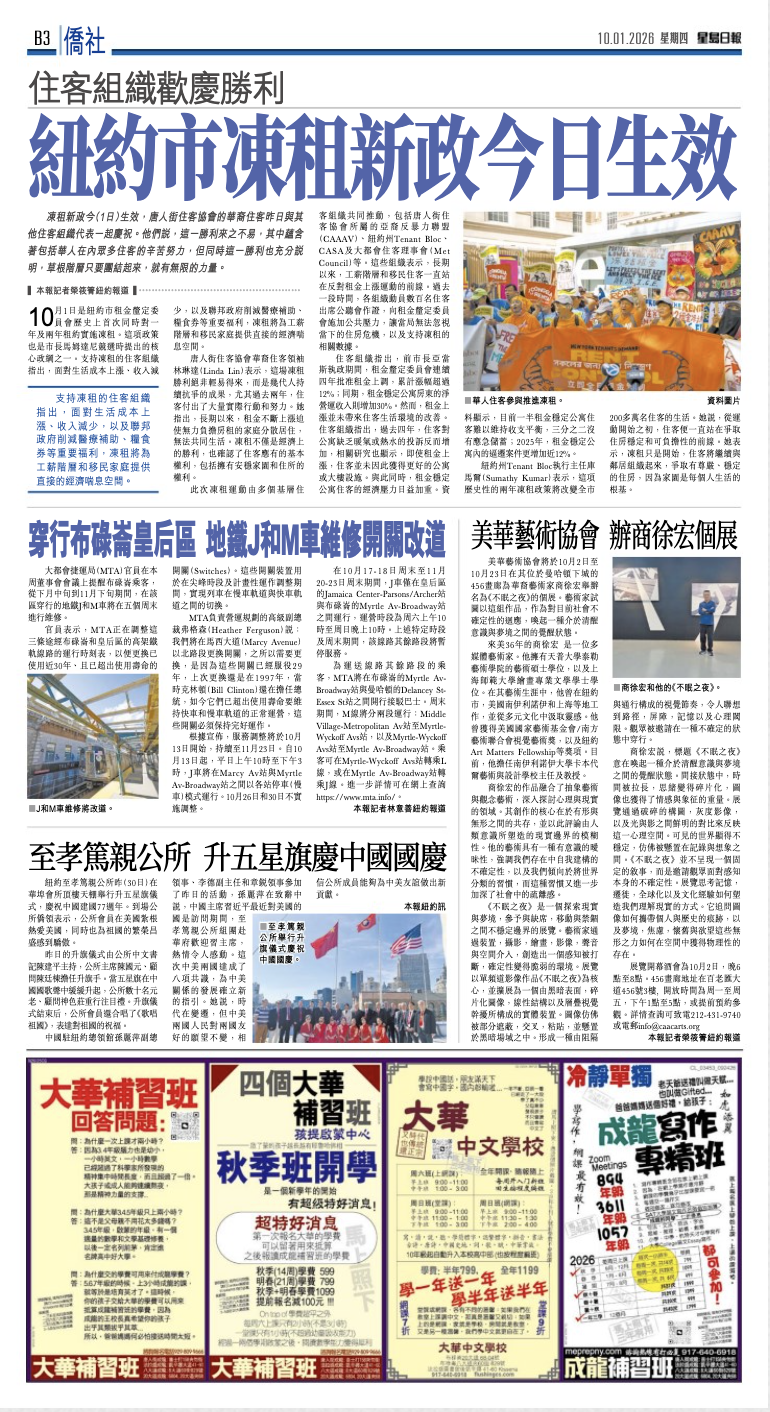
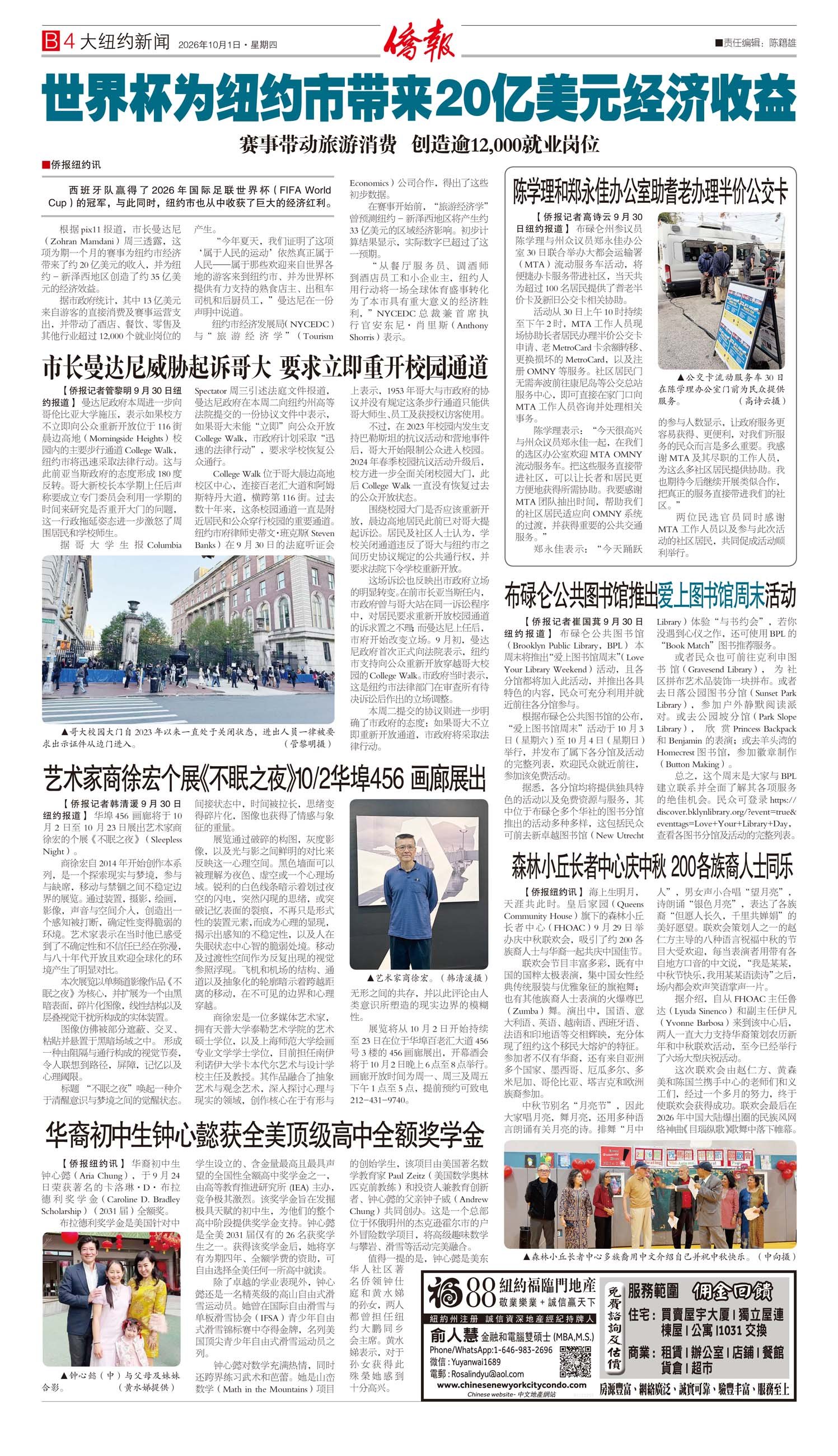
| 2026.2.12 | [Qiaobao / 侨报] 艺术家刘雨桐个展《susurrus | 声声私》华埠456画廊展出 ....more【侨报记者韩清湲2月12日纽约报道】艺术家刘雨桐个展《susurrus|声声私》将于12日至26日于华埠456画廊展出, 由Vu Thien An (Thea) Nguyen策展。
本次展览汇集了艺术家刘雨桐该系列创作的七件作品,呈现出一条垂直推进的路径,从伫立地面的形态,过渡到攀附墙面。角落承载重量,褶皱沉积密度,形态被允许成立于自身的物性之中。在作品中,形态由重力引导其到达,并停留。栖居并非占据,而是共振,承载空气、存在与关系。
艺术家的实践建立在对《老子》“空”的理解之上:中空是共振与调谐得以发生的前提。她以雕塑与声音为媒介,将中空的模块配置为递归的组合结构,拒绝完全的封闭与稳定的形式。展览将讨论延伸至形式如何经由其所保留、所隐去之物而发声。“susurrus”一词指向种轻微而内敛的低语——空气从腔体中以连续而微弱的方式流出,凝成停留的私语,贴近身体而不向外扩散。
刘雨桐2002年出生于中国北京,现生活和工作于美国纽约,其作品曾在美国与中国多地展出。她于 2025 年获得罗德岛设计学院(Rhode Island School of Design,RISD)雕塑专业艺术学士学位。其创作以雕塑与声音为主要媒介,从翻模过程中形成的空腔结构和模块化组合出发,探索“缺席”与“偏离”如何慢慢松解既有结构的连贯性。
Vu Thien An(Thea)Nguyen(生于2002年,越南河内)是一位新兴策展人与艺术研究者,现往返于纽约与河内之间工作与生活。她目前就读于帕森斯设计学院新学院(Parsons School of Design, The New School)设计史与实践(艺术史)专业,攻读艺术学士学位(2026届)。她的研究关注艺术如何作为文化转译的媒介,并逐渐将兴趣延伸至东南亚及离散社群的语境。
展览将从日开始持续至日在位于华埠百老汇大道456号3楼的456画廊展出,开幕酒会定于12 日晚 6 点至 8点举行。画廊开放时间为周一、周三及周五下午1点至5点,提前预约可致电212-431-9740。
|
| 2026.1.17 | 「World Journal 世界日報」3華人女藝術家詮釋「靈、仙、鬼」,1/16日展出 ....more位於曼哈頓華埠的美華藝術協會旗 下456畫廊16日起舉辦展覽「豔麗與愛情」。三位華人女性藝術家透過細膩的表達,對「靈、仙、鬼」的描繪,將觀者帶人如李碧華小說般的鬼魅意境中。 本次展覽由莫維凡及張舒涵策展,展出趙梓均、宋宜靜及李一可的作品。張舒涵表示,自己因想做一個融合「新中式」及女性氣質的展覽,與莫維凡一拍即合,陸續發掘了這三名在紐約的華人女藝術家。儘管三人作品的類型、創作時間均不相同,但貫穿其中的曖味性及模糊性卻讓她們氣質相似。 其中,出生於中國雲南的李一可帶來多幅繪畫及版畫。無論是自然歷史博物館中的海洋生物,或「聊齋志異」中聶小倩的故事,都成為李一可筆下靈感;透過這些題材,她在作品中討論生死,也投射隱密的哀傷情緒。 而來自台灣的宋宜靜則用多幅油畫表達對生死的看法。宋宜靜的作品中也有極強的佛教、道教元素,這來源於她在台灣的生活經驗;「23年一位很重要的長輩去世,我就開始紀錄下喪禮、光明燈以及觀音等等回憶中的形象」。 趙梓均的作品亦深受亞洲文化啟發,並將文化記憶中的符號、圖像及儀式,用個人視角進行重新建構。
....more
|
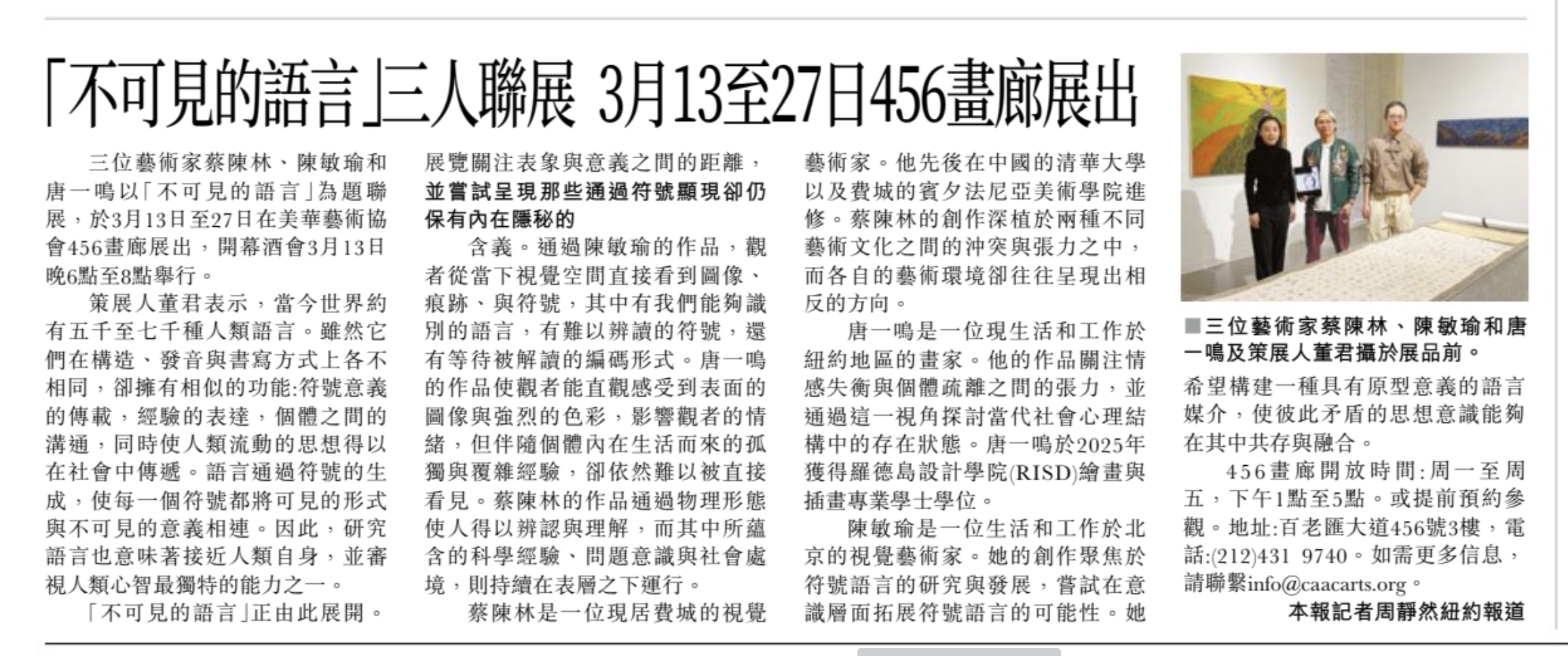
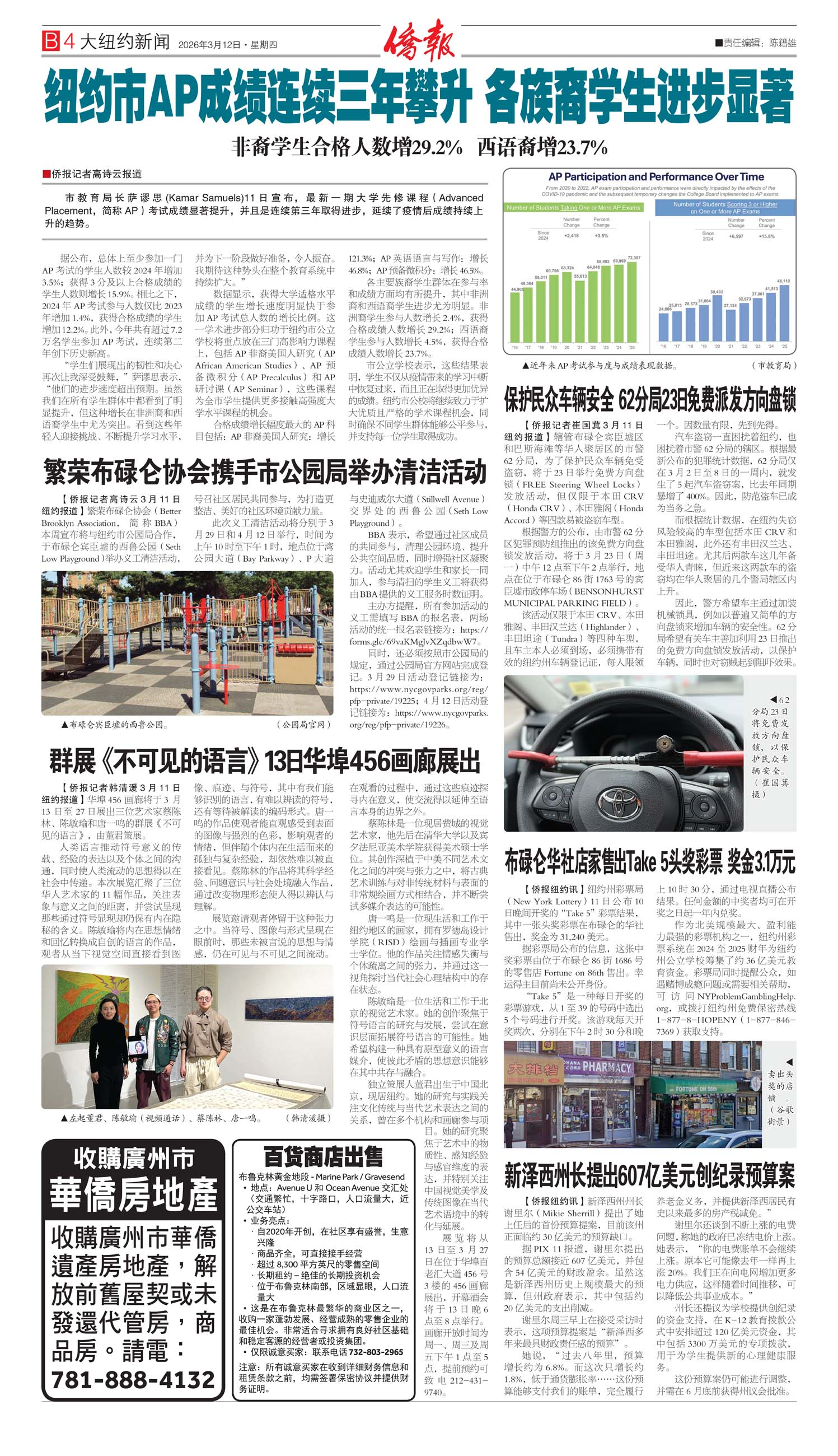
| 2026.1.15 | [Sing Tao Daily/星島日報] 趙梓均宋宜靜與李一可 「艷麗與哀情」 1/16展出 ....more本展由真維凡與張舒涵策長,她們表示,中國語塊中的「鬼」似有一種難以譯出的氣場。置身「鬼氣」的邏輯中,靈與魑魅並不被舉逐到某個超驗的他界。 中文的「鬼」總與生人並存,又在凡常的縫隙中異孌而生。它們是帶著幽異色澤的另一種「我們」。 「艷麗與哀情」展覽匯聚 了三位華人女性藝術家趙梓均、宋宜靜與李一可,她們以細密的感知力,將觀者帶入「靈、仙、鬼」那無法逃離的親密之中。所謂艷麗,在此被呈現為一種被內在靈性悄然喚起的專注——交纏的欲念、被悔意浸潤的想象。 趙梓均是一位現居紐約的藝術家,她的作品在多個國家展出,她的藝術創作深受亞洲文化的啟發,並以個人的方式對其進行解讀與敘述,由此逐漸形成了具有個人特征的藝術語言,關注文化傅承與個體身份之間的關聯。 宋宜靜是一位藝術家,插畫家與平面設計師,生於台灣台北,目前現居紐約。 她的作品以油畫為主要創作媒材,同時也探索雕塑、裝置、錄像等多元創作形式。她的作品深受台灣生活經驗,以及佛教與道教文化的啟發,並期許透過藝術傳達文化意涵,讓觀者在觀看中獲得療癒與沈澱的感受。 李一可是一位現就讀於紐約視覺藝術學院本科的藝術家,出生於中國雲南。 在雲南多元民族文化與原始自然景觀的沒潤中成長,她逐漸培養出對生命、自然與藝術交織律動的敏銳感知。她的創作跨越繪畫與版畫,將傳統技法與當代媒介交纖使用,介於具象與抽象之間。

|
| 2026.1.15 | 「Qiao Bao 僑報」华人女性艺术家群展《艳丽与哀情》華埠456画廊1/16展出 ....more华埠456画廊将于1月16日至1月30日展出三位华人女性艺术家艺术家赵梓均、宋宜静与李一可群展《艳丽与哀情》(ALure, A Lament),由莫维凡与张舒涵策展。 本次展览汇聚了三位华人女性艺术家的八组作品,她们以细密的感知力,将观者带人“灵、仙、鬼”那无法逃离的亲密之中,展览中也展现了不同艺术家作品之间的互文。所谓艳丽,在此被呈现为一种被内在灵性悄然唤起的专注——交缠的欲念,被悔意浸润的想象。古老之物在纸面的笔势、木板的刻痕、颜料的交织中散发气息。一种氛围悄然弥漫,仿佛维系着一场祭仪: 向过去无声祈祷,向隐伏在旧故事里的先人献上轻轻哀悼。灵与鬼从不与我们隔绝,我们的步伐本已随着它的脉动而起伏。 赵梓均现居纽约,其作品在多个国家展出并获得多项国际奖项,其作品也多次刊登于国际艺术媒体。她关注那些深嵌于文化记忆中的符号、图像与仪式,并通过个人视角进行重新建构。在她的作品中,传统与她自身精神世界之间的碰撞、融合与调和不断呈现,她始终与自身的亚洲文化背景保持联系,同时又在跨文化的环境中不断重新认识自己。 宋宜靜是一位艺术家、插画家与平面设计师,生于台湾合北,目前现居纽约。她的作品以油画为主要创作媒材,同时也探索雕塑、装置、录像等多元创作形式。她的作品深受台湾生活经验,以及佛教与道教文化的启发,并期许透过艺术传达文化意涵,让观者在观看中获得疗愈与沉淀。她毕业于台北实践大学服获设计学系,目前正在纽约视觉艺术学院(School of VisualArts)攻读艺术创作硕士。 李一可出生于中国云南,现就读于纽约视觉艺术学院本科。在云南多元民族文化与原始自然景观的浸润中成长,她逐渐培养出对生命、自然与艺术交织律动的敏锐感知。 她的创作跨越绘画与版画,并借助自然元素,以古典音乐为灵感,探讨美丽与脆弱、永恒与瞬息的共生关系,表达对逝去的生命以及哀情。 策展人之一的莫维凡来自浙江嘉兴,现在纽约新学院社会研究所(New School for Social Research) 哲 学系学习美学和批判理论,主要研究方向包括感知哲学、现象学、情动理论、古希腊哲学与戏剧,以及华裔离散文学与电影文本。另一位策展人张舒涵是 CHINCHINART的创始人,专注于数字艺术、文化平台与艺术市场的交汇地带,策划实践涵盖线下展览、艺术金融项目与跨界合作。

|
| 2025.12.13 | [World Journal /世界日報] 「在美華人如塑膠包裝」456畫廊實驗性展覽反抗藝術體制 ....more位於曼哈頓華埠的美華藝術協會旗下456畫廊12日起舉辦展覽「if」;現居英國倫敦的華人藝術家張繼馳以極為叛逆、大膽及具實驗性的作品,傳遞反抗現有藝術體制的表達。
本次展覽中的物品均為張繼馳在倫敦各地收集的後工業材料,如用過的塑膠包裝、塑膠外殼和透明的工業覆蓋物。他說,自己對於這些材料的熟悉與情感來自成長環境。
張繼馳在中國深圳長大,童年時的深圳正處於發展最為迅速的年代,建築工地隨處可見;這些充斥著大量鋼筋、混凝土及塑料的工地,也成了張繼馳兒時的探索樂園。
後來就讀於倫敦藝術大學中央聖馬丁藝術與設計學院的張繼馳說,從藝術院校、畫廊到藝術展觀眾,他所熟悉的藝術體制擁有挑選觀眾的權威;他則希望能透過呈現後工業材料,來對這種體制進行叛逆的諷刺,「我自己本身就是被體制化的人,這次展覽是我尋求出口,或者說與體制和解的方式」。
張繼馳表示,本次展覽的標題「if」,永遠只能附著在一個句子中存在,正如這些塑膠包裝一般,並非主角。「這也是為什麼我想在華人社區的畫廊中辦展,因為在美華人就像塑膠包裝一樣,不是社會主流」,張繼馳說,與此同時,這些塑膠包裝大多由中國的工廠製造,「在那裡,華人就像塑膠包裝一樣是主角,這都來自視角和語境的不同」。
本次展覽將持續至12月26日(周五),456畫廊開放時間為周一至周五下午1時至5時,地址:曼哈頓百老匯大道456號3樓,聯繫方式:info@caacarts.org。
藝術家張繼馳以極為叛逆、大膽及具實驗性的作品,傳遞反抗現有藝術體制的表達。(記者曹馨元/攝影)
....more
|
| 2025.12.12 | [Sing Tao Daily/星島日報] 藝術家張繼馳以「if」為題個展 12/ 12 至 26 日456畫廊展出 ....more張繼弛個展《if》於12 月 12至 26 日在456畫廊展出,12月12日下午6點至8點舉行開幕酒會,歡迎參加。
張繼弛表示,「if」這個簡單的詞彙,不連結任何句子、不承諾任何後果。它不作為起點,也不引向終點。這場展覽中的作品刻意地無定、未命名、無解構地堆疊在一起。半透明的人造皮膜、撕裂的複合表面、工業殘片的鈍角、反光膠的空氣折線,以極其倔強的方式拒絕「成為」任何藝術。
觀眾無法理解這些作品,但這正是目的。他們被迫從邏輯退場,從觀看退場,只能進入一個無法掌控的、隨時可能崩塌的臨場關係。
張繼弛關注的是臨時性的後工業材料——用過的塑膠包裝、塑膠外殼和透明的工業覆蓋物。這些原本用於承載或保護的物品,如今卻被賦予了無目的、無意義。
這些材料或折疊、或壓制、或輕柔地排列,都無法持久。摺痕會隨著時間的流逝而變軟,表面也會因氣壓而移動。他的作品展現的是生成狀態──安靜、不穩定且開放。觀眾被邀請靠近,調整步調,與模糊性共存。
張繼弛2001 年生於中國呼和浩特是一位現居倫敦的藝術家,畢業於倫敦藝術大學中央聖馬丁藝術與設計學院(2025),並於柏林藝術大學完成交換計劃(2024)。他將於倫敦大學學院(UCL)斯萊德美術學院攻讀碩士學位。其作品為多家機構收藏,包括 LAC(倫敦)、Atypia(上海)與遼寧大學(瀋陽)。
456畫廊開放時間: 周一至周五,下午 1 點至 5 點。或提前預約參觀。地址: 百老匯大道456號 3樓, 紐約市10013 (456 Broadway, 3rd Floor),查詢電話: (212) 431 9740 。
本報記者周靜然紐約報道
....more
|
| 2025.12.12 | [China Press / 侨报] 艺术家张继弛个展《if》华埠456画廊开幕 ....more |
| 2025.12.9 | [World Journal /世界日報] 亞裔同志先鋒聚456畫廊 探討身分認同 ....more |
| 2025.12.2 | [Cultbytes] Woven, Not Stranded: A Retrospective of The Web ....morePatricia Silva December 2, 2025
Between a much anticipated opening in 1990 and its closing in 2013 The Web, 盘丝洞, pulsed with American Disco and House music that kept crowds dancing well into the night. Three years before Lucky Cheng’s served brunches and employed Asian and Asian-American Drag performers in the East Village, an Upper East side multi-level venue on Madison Avenue at the East 58th Street corner was the first Gay Asian-owned Gay bar in New York City, a distinction that, sadly, remains unchallenged to this day. People of color own very few LGBTQ nightlife businesses in New York City. Aside from The Web and Alibi opening in Harlem in 2016, Queens was the only borough where Queer people of color owned LGBTQ+ bars. Twenty three consecutive years in Manhattan for any LGBTQ+ club is a significant feat. Clubs with far less duration have influenced generations, pop culture, and became legendary: Mineshaft was only open from 1976-1985.
The Web remains part of New York City’s undercurrents of modern Queer lore, a constellation of citywide locations well known to those who were there but obscure within the scope of mainstream recognition. A current exhibition at the Chinese American Arts Council is the first retrospective of this unique home for Queer Asian communities. Titled The Web: The Birth and Legacy of New York’s First Asian Gay Bar, and co-curated by Xiaojing Zhu and Yukai Chen, the exhibition features photographs, ephemera, and an installation to celebrate the cultural touchstone The Web was for so many Asian and Asian American New Yorkers.
Created by Alan Chow with business partner Chan and borrowed funds, the club was named after a 1967 film, The Cave of the Silken Web, “an erotic film about spider women in a cave who tempt visitors,” Yukai Chen explained, “and the internet too, because it was at a time when it started appearing in daily life.” Chow and Chan transformed a fire-damaged private club into a space where Queer Asian communities could find refuge, belonging, and collective power as organizers of the first Asian contingent in New York City’s Pride Parade.
Mr. Chow, a Taipei-born actor who relocated to Hong Kong for a successful acting career, moved to New York City in 1971 and began promoting Chinese opera in addition to starting a small souvenir business. Mr Chow also had the starring role in The Cave of the Silken Web, among other Shaw Brothers Pictures in Hong Kong. As the founder of The Chinese American Arts Council, Mr. Chow maintains the photographic archive of The Web at CAAC and supports a growing roster of artists with an independent gallery.
What follows is an interview with co-curators Yukai Chen in New York, who works closely with Mr. Chow at the CAAC gallery, and Xiaojing Zhu in Beijing.
Patricia Silva: I’d like to start with Mr. Chow. Where did Mr. Chow live before starting The Web?
Yukai Chen: Mr. Chow was born in Taiwan. His family was from Shanghai and owned Ming Sing Florida Water, a famous cosmetic brand. When Mr. Chow moved to New York in 1971 he realized there was a need for a space where Gay Asian immigrants could hang out. Going to the existing Gay bars could be intimidating for those who didn’t speak English, so he co-founded The Web.
At first, Mr. Chow had two business partners but they didn’t like each other. The other partner David went downtown to lower Manhattan and opened his own bar, but it only survived for a short time. Mr. Chow eventually opened The Web with Chan.
What was on that opening night playlist? At this time, I was listening to Faye Wong covers of Western songs.
Yukai Chen: I love Faye Wong too, but The Web actually didn’t play many pop songs from East Asia. Mr. Chow said their playlist included American songs, mostly 1990’s Disco and House vibes.
On opening day it was packed. It caused quite a stir — people were lining up all the way down 54th Street. While Mr. Chow was promoting the club’s opening, people actually waited a long time, about two months, because funding and renovations weren’t ready yet. That long build-up made everyone even more excited, which is why so many people showed up when The Web finally opened.
Why did The Web close?
Yukai Chen: It closed in 2013 because of the rising rent and people not going to Gay bars anymore after dating apps appeared. Mr. Chow also said 9/11 was a turning point: people were afraid to go to crowded public spaces, but The Web still existed after 9/11 until 2013.
I would love to hear about the importance of Go-Go Boys at The Web. Every photograph in the show portrays a conventionally attractive Go-Go Boy, gym-chiseled, but in American media in the 1990s Asian masculinity was portrayed very differently, if at all.
Yukai Chen: During my interview with the mural painter Chen Danqing, now a famous artist and critic in China, he mentioned that The Web successfully showcased the different aspects of Asian men. I mean, there’s Bruce Lee, of course, but seeing so many Asian men knowing they are sexy and unapologetically proud of it was rare for Americans. Chen Danqing said every time The Web’s float came out during the NYC Pride Parades, the audience would go crazy. That’s how The Web won The Most Outstanding Float four times. Chen Danqing vividly remembered that during one parade, there was a white man following The Web’s float, dancing and cheering with his headphones on. I believe The Web’s atmosphere was contagious.
Most of the Go-Go boys at The Web had day jobs. A customer of The Web came today and told me he knew a Go-Go boy who saved his one-dollar bill tips in a large plastic trash bag—and he used them to buy a laptop for school! The cashier was shocked and was unwilling to take these bills, but the Go-Go boy unapologetically insisted that money is money and eventually got the laptop. I’m happy for him. One of the Go-Go boys in the pictures also came to the show and told us that he and his husband now have two boys, and they still live in New York! I think it’s vital to remember that The Web provided a lot of job opportunities.
What kind of events happened at The Web?
Yukai Chen: Drag shows, ballrooms, and male pageants like the ones from the Asian Prince competition we included in the show. The pageants were the most popular, Mr. Chow hosted them monthly and hosted the Asian Mr. Prince. The Web also provided complimentary AIDS tests for the community, held countless informal same-sex weddings, and offered English lessons to help new immigrants adapt. Mr. Chow also told me there was a millionaire’s private club that rented The Web and its members put on drag performances for fundraising events, and Mr. Chow donated part of The Web’s revenues to the Chinese American Arts Council. It was also a “chosen family” for young people estranged from their biological homes.
Just yesterday, I was talking to the legendary New York drag performer Candy Samples, and I mentioned The Web. Candy told me that Jiggly Caliente used to work there.
Yukai Chen: Yes, she did! I was just talking to a photographer who took photos of The Web, and he remembered seeing Jiggly perform. He even found an image of Jiggly in Chun-Li costume!
Incredible! And what was the connection between The Web and the restaurant Sarong Sarong? Although I never went to The Web I did eat at Sarong Sarong, because I worked nearby. The exhibition installation has the original menu.
Yukai Chen: Sarong Sarong was an extension of The Web, a Malaysian restaurant on Bleecker Street. Some people actually knew Sarong Sarong first before The Web.
Xiaojing designed the bar table area, and we all liked this idea. It mimics the scene of the restaurant, people can sit down and look through the menu and they can read the romantic story Tea For Two inspired by The Web, written by Pai Hsien-yung.
As curators, what did you want to communicate with this exhibition?
Xiaojing Zhu: What I wanted most was for the audience to feel what I felt when I first encountered the archives: pride. Using these documents to bring back those vivid days was my first instinct after hearing about The Web, its energy and its abrupt, regrettable, ending,
Yukai Chen: We want the exhibition to showcase the spirit of The Web. It was a unique anchor for Gay Asian immigrants, a place they called home. And we hope more people get to know it and get inspired by its rich history. The fact that it existed is already so powerful.
What was the process of making the photographic selections and building the installation?
Yukai Chen: We really like the image of the handsome Go-Goy boy with the blue Speedo sitting at the Christmas theme stage. We used it for the zine cover. His gaze is so powerful and of course, his sculpted body is also fascinating. Mr. Chow told us he was a popular star at The Web, many people came just to see him.
Xiaojing Zhu: I used two wall-sized vinyl prints to shape the exhibition’s atmosphere.
Yukai Chen: One shows The Web’s float during 2001’s Pride Parade, the other presents the mural Chen Danqing painted in The Web’s basement, with Mr. Chow moving and the cameraman following. These two serve as openings of daytime and nighttime.
Xiaojing Zhu: At the first glance, you see a group of radiant, passionate, friendly, and proudly Asian Gay men dancing on the parade float. Turning right into the space you will see the bar tables and the mural painted by Chen Danqing. I hoped the installation could offer, even briefly, a sense of being there.
Yukai Chen: We divided the space into two main areas: the audience follows the route of The Web’s float from uptown to downtown Manhattan, where we also display the zines. Then they enter The Web’s nightlife scenes displayed in the middle room by Chen Danqing, and another area that showcases archival photographs of The Web’s nightlife.
What was it like going through Mr. Chow’s archive at the CAAC?
Xiaojing Zhu: I first learned about The Web from Mr. Chow. He rarely spoke about it, even though it inspired Bai Xianyong’s well-known story “Table for Two.” I read his book The New Yorker five years ago, and returning to the bar’s story felt like tracing a thread across time. In the exhibition, the table-for-two installation echoes that literary reference: not only as an atmospheric element but also as a place to display the archives. Together, I hope they make clear the bar’s layered character and its enduring legacy in the history of anti-discrimination and the Asian gay community.
These archives and people built visibility, solidarity, and culture long before such stories were widely acknowledged. The exhibition invites you to see their presence: inside a bar that became a home for a once marginalized group and gathered every member out on the Pride Parade. It’s a chapter of New York’s once veiled social history.
Hong Kong’s Sing Tao Daily featuring The Web’s New York City Gay & Lesbian Pride float on cover, 2007. Scanned and edited by Yukai Chen. Chinese American Arts Council Archives.
Yukai Chen: I first encountered the archives of The Web when I started working here. The fact that Mr. Chow, our Director, was once the owner of an Asian Gay bar really fascinated me. Then I learned more about his story: how, after finishing work at CAAC, he would drive Drag Queens to The Web; how he even donated part of his earnings from the bar to CAAC to support Chinese artists. These are such powerful, unexpected stories that deserve to be remembered.
Chen Danqing said something that really stayed with me: that Asian people are often reserved and shy, and The Web not only gave Queer people a sense of liberation but also other Asian people like him a sense of liberation. It showed him, and others like him, what freedom and self-expression could look like.
By bringing back the history of The Web, we want to celebrate its vibrant legacy and its contributions to the Asian community. But more than that, we hope the exhibition encourages people to think about the power of community—how people come together in the face of marginalization, and to imagine new spaces where every culture can co-exist and thrive.
The Web: The Birth and Legacy of New York’s First Asian Gay Bar is on view through December 5 at Chinese American Arts Council / Gallery 456, 456 Broadway, 3rd Floor, New York.

|
| 2025.11.25 | [Gay City News] A bar of our own: Archival photographs revive legacy of NYC Asian gay bar The Web ....moreBy Nicholas Boston
While the gay bar is not dead yet, it has been on life support ever since dating apps came out.
“The Web: The Birth and Legacy of New York’s First Asian Gay Bar” is a priceless exhibition of archival photographs and other media on view at Gallery 456 of the Chinese American Arts Council (CAAC), which transports visitors back to a time and place that is all but forgotten in public memory.
From 1993 to 2013, The Web occupied a multilevel space on 58th Street between Madison and Park Avenues, across from Bloomingdale’s. It was established by Shanghai-born CAAC founder and director Alan Chow, and his business partner, Chan.
Chow arrived in New York City in the early 1970s with a background in film acting and directing in Hong Kong. He soon grew aware of the discomfort many immigrant Chinese and Asian gay men like himself felt in mainstream gay bars. The opportunity to open a bar “of our own” presented itself when a fire-damaged lounge off the gay beaten track of downtown Manhattan came available in midtown at below-market rent.
Not only was the price right, so was the timing. At that very moment, diverse communities were stepping out from beneath the generic queer umbrella to express culturally distinctive identities and experiences. There was an upsurge in Asian LGBTQ organizing and visibility (Gay Asian & Pacific Islander Men of New York, GAPIMNY, was founded in 1990).
The Web quickly amassed a loyal clientele. It evolved from a destination to dance and date, to hosting special events like the “Asian Prince” male beauty pageant and gay weddings before same-sex marriage was legalized in 2015. As its reputation grew, the venue attracted celebrity visitors, often by Chow’s invitation or connection. Actress Zhang Ziyi of “Crouching Tiger, Hidden Dragon” fame was photographed there.
“The initial Chinese name of the club means ‘web,’ and inside the bar we actually installed a giant net,” Chow said in a published interview. “Guests could climb on it and play around.”
The Web’s biggest public showing was a dazzling float it sent down Fifth Avenue in the yearly Pride Parade, the first time a float of all-Asian drag queens and go-go boys was entered. It won “Best Float” four years in a row.
Photographs of all these activities and events, some taken by Chow himself, some by unknowns, lay unseen in the CAAC files for decades until art photographer Yukai Chen, the current CAAC program manager, stumbled across them and was captivated.
“It’s so avant-garde,” said Chen, a Brooklynite of Chinese origin who was barely into his teens when The Web closed in 2013. “The photos, when you see them, you feel like it’s so modern. People don’t feel like it is back in the nineties.”
The idea for an exhibition was born.
Upon entering the gallery space, you are met with a full-wall photo of chiseled men in teeny-tiny gold lamé skirts, dancing atop the brightly colored Pride float. This leads into a trail of smaller photos and archival media clippings that picture them along the parade route. You are then plunged into the bar itself, witnessing various artsy-erotic goings-on, images of dancers, patrons, and special guests. Installed in the center of the space is a recreation of a table at “Sarong Sarong,” the Malaysian-themed restaurant, also now defunct, that Chow opened on Bleecker in extension of The Web.
As lead artist of the exhibition, Chen produced an accompanying zine that features a lengthy interview with Chow and the celebrated painter Chen Danqing, in whom Chow entrusted the bar’s interior design. Danqing painted striking murals interpreting “east meets west” on the walls of the bar’s basement level, visible in the background of some of the photos.
The Web’s main attraction was its bevy of loinclothed go-go boy dancers. They hailed from various East Asian countries — China, Japan, Vietnam, among others — and made anywhere between $250 and $3000 a night in tips, Chow and Chen said.
No shortage of photos in the exhibition picture them. Muscled or smooth, projecting seductive stares or disarming smiles, most of their names and lives post-Web are now unknown.
“They are probably in their late fifties, early sixties now, these go-go boys,” Chen said.
One photograph begs a question about the audience’s gaze: a close-up of a go-go boy oiling his bare torso while in the background a white guy ogles him. In the nineties when these men were working, outward expressions of racial fetishization were far more explicit in gay life, night and day. There was even a lexicon to describe it. White men who sexually fixated on East Asian men were “rice queens”; those who pursued South Asians were “curry queens”; “chocolate queens” were into Black men; and “snow or vanilla queens” were men of color who exclusively pursued white men.
An estimated 30 to 50 percent of The Web’s clientele at its peak were white gay men, skewing above 40.
“I don’t know how people felt back then,” Chen said. “But, Alan told me, ‘Asian people don’t buy drinks that much.’ Maybe the white people contributed a lot to the revenue.”
“I often felt sympathy for some of the older white gay men,” Danqing says in the zine interview. “Shy, lonely, yet, as long as they could spend an evening in an Asian gay bar, they were happy.”
I visited The Web a couple of times myself. I was Black, which I still am, and young, which is now debatable. While the circumstances and motivations for going there are lost in the morass of nightclub visits I made back in the day, I clearly remember the vibe of the place. It was gay first and foremost, yes, but the gay authority there was different from the one calling the shots, literally and figuratively, in most other gay venues.
“I remember you,” Chow said to me when I met with him at the exhibition last week, clearly jocularly, but with the warmth of welcome the proprietor of any successful establishment knows how to give.
Then, he took me by the wrist and said, “Let’s take a picture.”
Editor’s Note: This story originally referred to The Web as NYC’s first Asian gay bar, as described by the exhibition’s title. We have since learned that earlier Asian gay bars existed, and the story has been updated accordingly.
The Web: The Birth and Legacy of New York’s First Asian Gay Bar | Gallery 456 | Until Dec. 5, 2025
Nicholas Boston, Ph.D., is a professor of media sociology at Lehman College of the City University of New York (CUNY). Follow him on X @DrNickBoston and Instagram @Nick_Boston_in_New York

|
| 2025.11.19 | [DAZED] ‘A space to let your guard down’: The story of NYC’s first Asian gay bar ....more‘A space to let your guard down’: The story of NYC’s first Asian gay bar
November 19, 2025 Text James Greig
From sexy pageants to illegal gay weddings, The Web explores a fascinating chapter in the city’s queer history
From its launch in 1990 to its closure in 2013, The Web – a bar at the corner of Madison Avenue and East 58th Street – was at the heart of New York’s Asian gay community, providing a refuge for people who often faced prejudice and exclusion within the mainstream gay scene. The venue organised the first Asian contingent at New York’s Pride Parade, winning ‘best float’ for four consecutive years in the early 2000s, and offered a range of life-changing services, from free English lessons to gay wedding ceremonies (long before this was actually legal).
Gathering together photographs, archival materials and a new zine, The Web: The Birth and Legacy of New York’s First Asian Gay Bar is a new exhibition which preserves what curator Yukai Chen describes as “powerful, unexpected stories that deserve to be remembered”.
The Web was founded by Alan Chow, who was born in Taiwan and worked as an actor in Hong Kong before moving to New York in the early 1970s. When he first arrived in the city, he realised there was a real need for a space like The Web. “Many Asian gay men around me were searching for somewhere they could truly feel at home. Back then, a lot of us were new immigrants – many didn’t speak English, myself included – and the idea of going to an American gay bar could be intimidating,” Chow tells Dazed.
The Web soon established itself as an important social space. “We didn’t have dating apps or online communities back then, so The Web became a place where people could meet, hang out, and connect with others who shared similar experiences,” says Chow. The bar also created work opportunities for Asian migrants who had recently arrived in the city. “Being a go-go dancer was a popular job – people could earn a lot in tips in one night,” says Chow. “But for many, it wasn’t just about money but also confidence. It was a way to be seen and appreciated in a world where Asian men often weren’t.”
Chen first encountered The Web’s archives when he began working at The Chinese American Arts Council (CAAC), an organisation which Chow founded in 1975. “The fact that Alan – our director – was once the owner of an Asian gay bar really fascinated me,” he says. “Then I learned more about his story: how after finishing work at CAAC, he would drive drag queens to The Web; how he even donated part of his earnings from the bar to CAAC to support Chinese artists.” By archiving and exhibiting this history, Chow and Chen want to celebrate the bar’s vibrant legacy and its contributions to the Asian community. “More than that, we hope the exhibition encourages people to think about the power of community – how people come together in the face of marginalisation – and to imagine new spaces where every culture can co-exist and thrive,” says Chen.
The exhibition is divided into two sections: one that follows the route of The Web’s parade float at New York Pride, and one which showcases archival photographs of the bar itself: pageants and parties; rehearsals for a dance performance at the Lincoln Centre and the filming of a documentary about Chinese opera, and lots of beautiful men with impossibly sculpted abs.
The photos which make up the exhibition were taken from Chow’s personal yearbooks, before being carefully scanned and reprinted by Yukai. “Since so much time has passed, Alan doesn’t remember exactly who took each photo, though he believes some of them were taken by himself,” Yukai says. In an immersive touch, the space recreates part of the Web’s interior design, setting up tables and chairs which mirror its restaurant layout, complete with the original menu.
The exhibition is accompanied by the publication of a new zine which serves as an oral history of The Web, based on interviews with Chow and Chen Danquing, who painted the bar’s murals. “During our conversations, we looked through the archival photos together, and they recalled stories from when The Web was alive – the people, the energy, the moments that defined it. The visuals in the zine respond directly to these memories,” says Chen.
During the years he spent running The Web, what made Chow happiest was seeing how it became an anchor for so many, a place where they could feel safe and accepted. “I’m especially proud that [we] hosted so many gay weddings, and I even served as a witness at some of them. It was incredibly moving to see people’s love and dedication to each other. Even though same-sex marriage was still illegal at the time, these ceremonies were a way to express love openly, and to show that love lifts people up, no matter the form it takes,” he says. Like any bar, things could get a little messy. “There were the occasional thefts, and sometimes people got drunk and brought their arguments inside. But that was all part of its life and energy,” he continues.
Because The Web offered its spaces for rent, it was used by all kinds of groups, including, according to Chen, a club of millionaires who would rent it for extravagant fundraisers. “They were men from big corporations who, for one night, would put on make-up and high heels and host drag beauty pageants. I think that really captures what The Web was – a space where anyone could let their guard down and be themselves.”
The Web: The Birth and Legacy of New York’s First Asian Gay Bar is running at Gallery 456, New York, from November 14 to December 5, 2025.

|
| 2025.11.18 | [World Journal /世界日報] 紐約首間亞裔同志酒吧 盤絲洞特展 ....more |
| 2025.11.14 | [Sing Tao Daily/星島日報] 「盤絲洞:紐約第一家亞裔同志酒吧」展11/14至12/5四五六畫廊舉行 ....more |
| 2025.11.14 | [China Press / 侨报] 《盘丝洞:纽约第一家亚裔同志酒吧的诞生与遗产》展览将于456画廊展出 ....more |